
AI Films Are Getting Good Enough. Storytelling Still Has to Be Better.
AI is making filmmaking dramatically faster, cheaper and more accessible. For prototypes and social content, “good enough” can already be enough. But as AI films move toward theatrical and OTT experiences, consistency, performance, sound and storytelling become far harder to compromise on.
AI Is Changing the Speed of an Idea
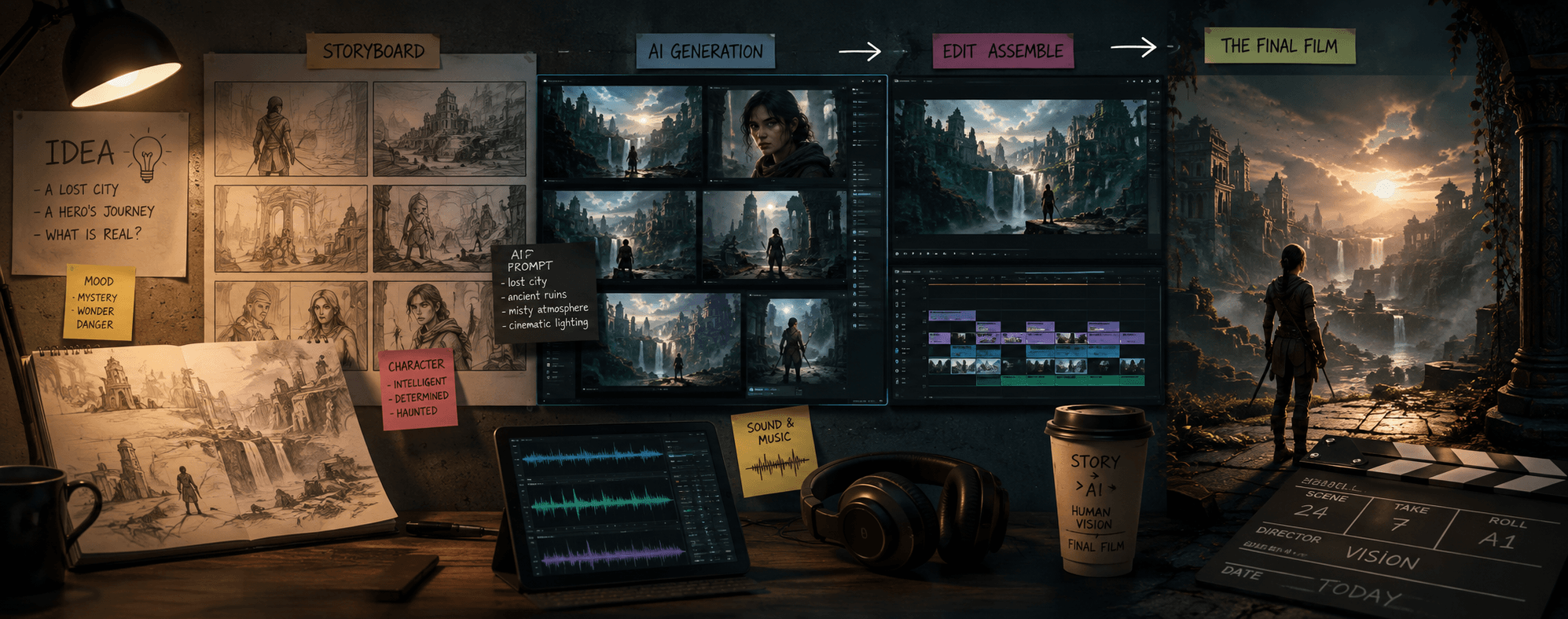
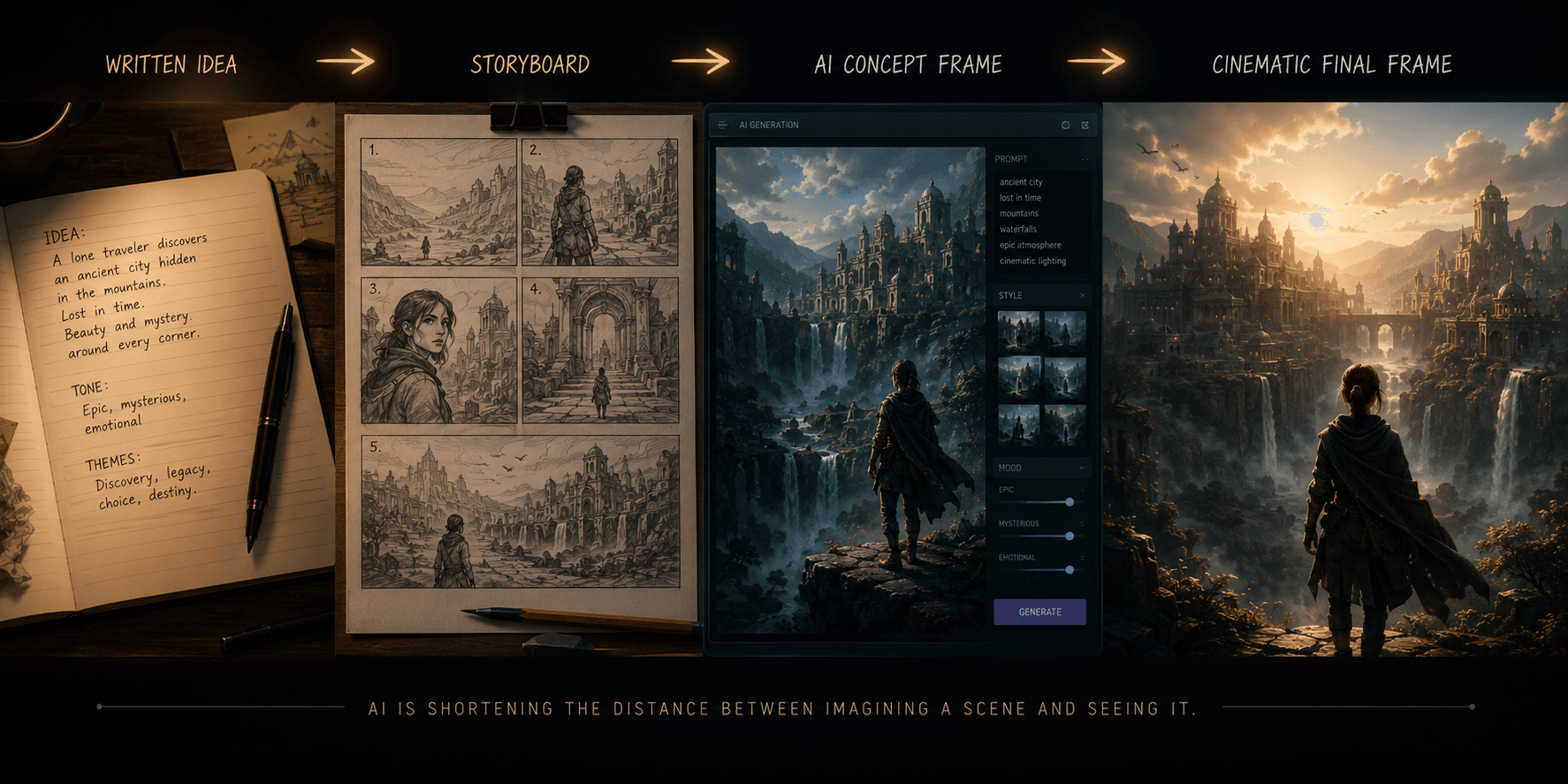
For most of filmmaking history, there has been a significant distance between imagining something and actually seeing it. A writer could describe a world. A director could explain a shot. A production designer could sketch a location. But to really see the idea come alive required people, equipment, locations, sets, actors, post-production and, most importantly, time. AI is rapidly collapsing that distance. A filmmaker can now start with a thought in the morning and, within hours, see versions of the characters, environments, shots, movement, voices and even music that could belong to that idea. That does not necessarily mean the final film has been made. It means something equally important has changed: the prototype of the film can now exist much earlier. And that is a significant shift for storytelling.
From Explaining an Idea to Showing It
One of the biggest benefits of AI filmmaking is not simply that it can generate images or videos. It is that it makes ideas easier to communicate. Instead of telling someone: A large abandoned palace stands in the middle of a flooded city. It should feel beautiful, but slightly unsettling. You can show them. Then you can change it. Make the palace older. Change the weather. Move the scene to dusk. Make the water calmer. Change the architecture. Put the character closer to camera.
An idea that previously had to survive multiple layers of interpretation can now be tested visually almost immediately. This makes ideation much faster. Writers can see whether a scene they imagined actually works visually. Directors can experiment with compositions before production. Production designers can test environments. Producers can understand the scale of an idea much earlier. Perhaps most importantly, teams can reject bad ideas faster. That is an underrated advantage. The value of rapid prototyping is not only discovering what works. It is discovering what doesn't work before large amounts of time and money have been committed to it.
The 80% Film
There is another interesting change happening at the same time. Audiences have become surprisingly tolerant of imperfections in AI-generated content. A character may move slightly unnaturally. A background may change between shots. An object may disappear. Lip sync may not be completely accurate. A face might look a little different for a few frames. A few years ago, many of these mistakes would immediately make a piece of content feel unusable. Today, viewers increasingly recognise the visual language of AI. They understand what they are watching. And because they understand the medium, they often accept some of its limitations. This creates what we could call the 80% film. It may not have perfect continuity. It may not survive frame-by-frame inspection. But if the idea is interesting, the images are engaging and the story communicates what it needs to communicate, the audience may still enjoy it. For certain forms of content, that is more than enough.
Where 80% Is Already Enough
Social media is probably the clearest example. A 20-second Instagram film does not carry the same expectations as a two-hour theatrical feature. People are scrolling quickly. The idea has to land. The first few seconds have to create curiosity. The visual needs to feel fresh. The ending needs to reward the viewer. If a tiny detail changes between two shots, most people simply do not care. This makes AI extremely powerful for social campaigns, concept films, experimental content, pitch videos, mood films and visual prototypes. A brand can explore ten ideas instead of producing one.
A filmmaker can test several visual directions before choosing one. A studio can create an internal proof of concept for a story before deciding whether it deserves a larger production. In these situations, chasing the final 20% of technical perfection may actually defeat the purpose. Speed, exploration and learning can be more valuable.
But a Prototype Is Not the Final Experience
The problem begins when we assume that because AI can produce an impressive individual shot, it can automatically produce an equally impressive film. Films are not collections of beautiful images. They are continuous experiences. A character who appears in Shot 4 has to feel like the same character in Shot 40. Their costume needs to remain consistent. The geography of a room needs to make sense. The direction someone is looking needs to connect with the following shot. Emotion has to develop across a scene rather than reset every time a new clip is generated. The camera language has to feel intentional. And the audience should stop thinking about how the film was generated. That is where AI filmmaking becomes significantly harder.
AI Makes Making Easier. It Does Not Make Choosing Easier.
This may ultimately be the most important change AI brings to filmmaking. For decades, production limitations naturally restricted the number of choices a filmmaker could explore. You could not practically shoot 100 versions of every idea. AI changes that. Suddenly, thousands of possibilities are available.
Different lenses. Different locations. Different performances. Different costumes. Different worlds. Different edits. The bottleneck therefore starts moving. The difficult part is no longer always making something. The difficult part becomes knowing what is worth making. That puts even greater importance on taste, storytelling and direction. When anyone can generate an image, selecting the right image matters more. When anyone can generate a shot, understanding why that shot should exist matters more. When creating becomes cheap, decision-making becomes valuable.
The Story Still Has to Lead
AI will continue improving. Characters will become more consistent. Lip sync will improve. Generated music will become more controllable. Editing systems will understand continuity. Production pipelines will connect writing, images, video, voice and sound more intelligently. Many technical problems we see today will probably become significantly smaller. But none of that removes the fundamental question behind filmmaking:
Why should someone keep watching?
Technology can make a dragon. Storytelling has to make us care whether it survives.
AI can generate a city. Storytelling has to make us understand what losing that city would mean. AI can create a character. Storytelling has to make that character matter. That distinction is going to become increasingly important.
The Opportunity Is Not to Replace Filmmaking
The most exciting way to think about AI is not as a cheaper replacement for the traditional filmmaking process. It is as a new layer within it. AI allows filmmakers to prototype earlier, explore further and communicate ideas faster than before. For some forms of content, particularly social and experimental work, AI may already be capable of producing the final output. For premium films, OTT and theatrical experiences, it is more likely to become part of a much more controlled pipeline — with human direction, stronger consistency systems, sound design, editorial judgement and repeated quality checks around it. The standard will keep rising. And that is a good thing. Because eventually audiences will stop being impressed simply because something was created using AI. They will simply ask whether it was good. At that point, we arrive back at the thing that mattered before AI existed:
the story.