
The Future of Rides May Not Be a New Ride. It May Be the Transition Between Them.
For decades, amusement rides, water rides and adventure attractions have largely existed as separate categories. The next wave of innovation may come from removing those boundaries—creating continuous experiences where guests move from one ride system into another without breaking the journey.
Most Rides Still Belong to a Category
Walk through almost any amusement park and the attractions can usually be placed into familiar boxes. There are roller coasters for thrill. Water rides for splash. Dark rides for storytelling. Adventure attractions for physical participation. Lazy rivers for relaxation. Each experience generally begins when the guest boards and ends when they get off.
Innovation has traditionally happened inside these categories. Roller coasters became faster, taller and more dynamic. Water slides became steeper and more complex. Dark rides added projection, trackless vehicles and interactive systems.
But something more interesting is beginning to happen.
The categories themselves are starting to merge.
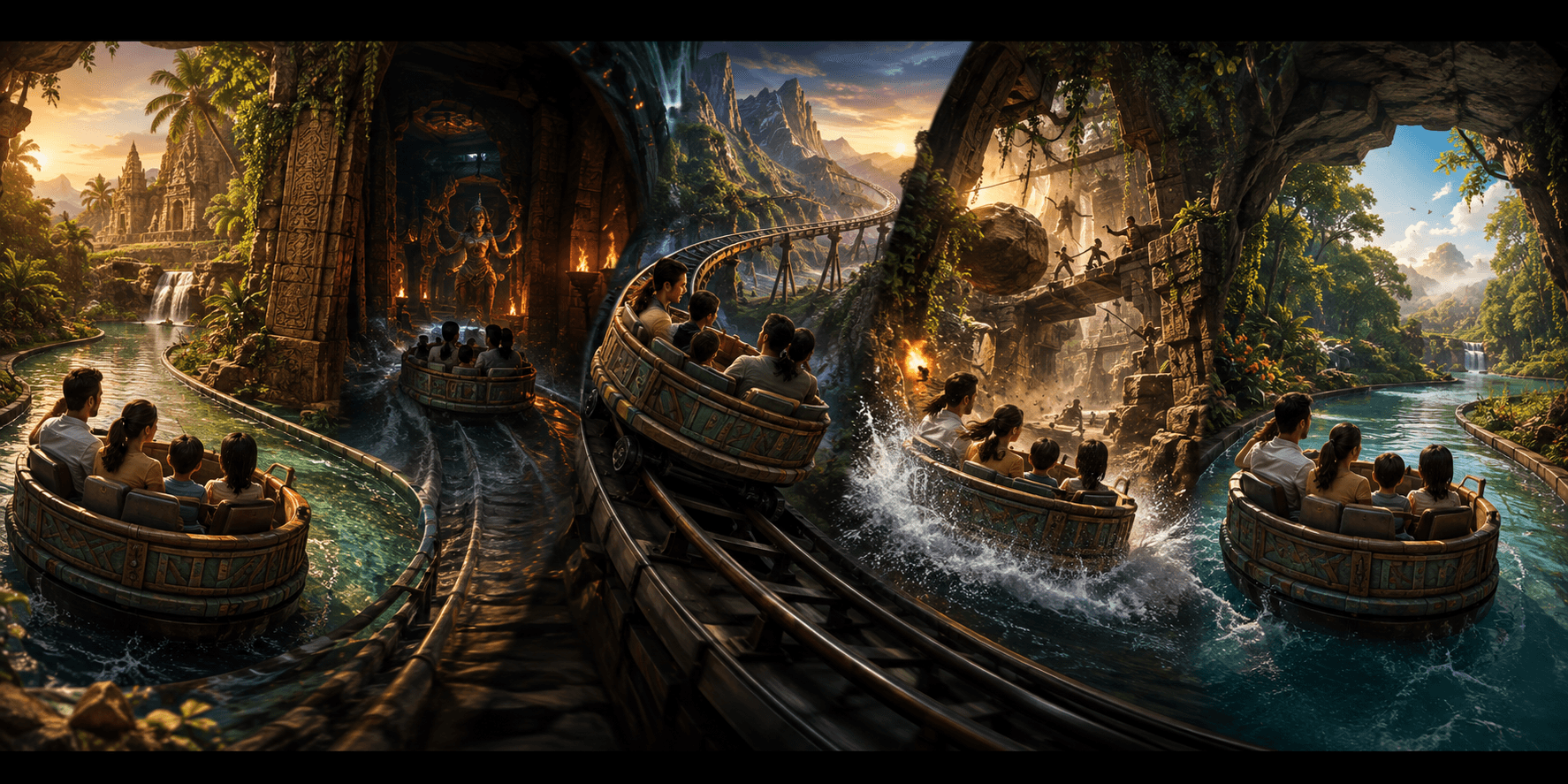
Mack Rides already describes its Water Coaster as a hybrid between coaster and water ride, moving seamlessly between track sections and water channels. Its Mission Bermudes attraction at Futuroscope goes even further, combining dark-ride storytelling, coaster dynamics and water attraction elements within one journey. Intamin has similarly introduced flume elements inspired by roller-coaster technology, including vertical lifts, spikes, moving switches and controlled drops.
These are early signals of a bigger idea.
The future may not be about asking, “What new ride can we build?”
It may be about asking, “Why does this ride have to stop here?”
What If the Guest Never Had to Get Off?
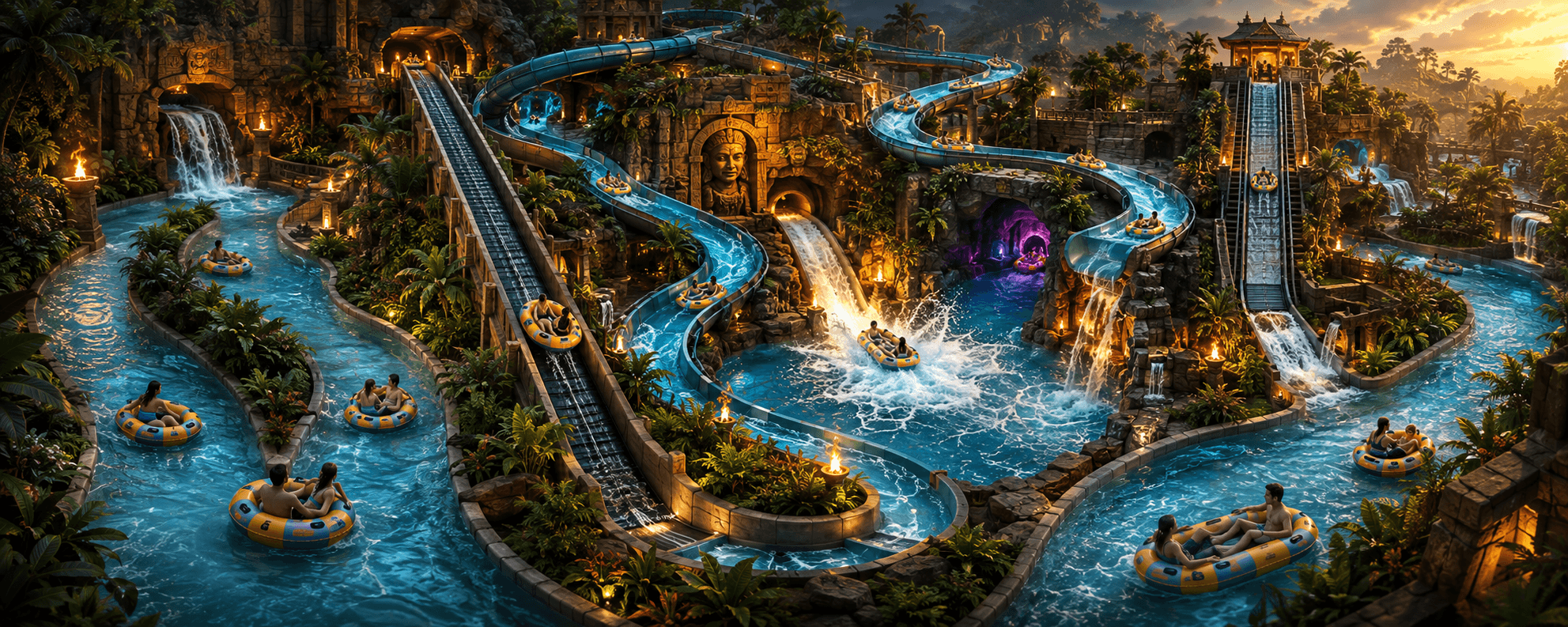
Imagine entering a water attraction in a tube.
You begin in a slow-moving river. The current takes you through a landscaped environment before the tube enters a lift system. You remain seated while the system carries you upward.
At the top, you enter a faster enclosed slide.
That slide eventually opens into another water channel. Instead of climbing out and walking back to another staircase, your tube simply continues.
You drift into another lazy section, enter another lift, select another route and continue.
The guest has not experienced a slide followed by a lazy river.
They have experienced one continuous water journey.
This changes something fundamental.
In most water parks today, the attraction is repeatedly interrupted by logistics. Exit the pool. Carry the tube. Walk across the deck. Climb the tower. Queue again. Board again.
The experience stops and operations begin.
What if the operations disappeared into the experience?
Suggested Image Block — Wide
A cinematic isometric 4:1 visual of a continuous water attraction. Guests remain inside their tubes while moving from a lazy river into an automated water lift, then into a slide, splash pool, themed cave, another lift and back into the river. Multiple routes branch and reconnect, creating a loop that can continue without guests needing to leave their tubes.
Caption: What if the ride ended only when the guest decided to leave?
The Transition Can Become the Innovation
This is the part of ride design that is often overlooked.
We spend enormous amounts of effort designing the attraction itself, but far less attention on what happens between attractions.
A guest experiences a roller coaster, exits, walks to another part of the park, joins another queue and boards a boat ride.
Those are two attractions.
But imagine if the boat entered a building, locked into a guided system, accelerated onto a coaster section, slowed into an immersive story scene, descended through a splash sequence and finally returned to water.
Suddenly, the transition between ride systems becomes part of the story.
Technology is already moving in this direction. Mack's latest multi-launch water coaster can accelerate boats repeatedly, including from water sections, rather than relying on the traditional structure of one lift followed by one downhill ride. Intamin's newer dark-ride systems combine trackless movement, 360-degree rotation and high-speed launch sections within the same vehicle platform.
The important innovation is not simply speed.
It is changing the behaviour of the vehicle during the journey.
One Vehicle. Multiple Experiences.
This opens a much larger design possibility.
What if the ride vehicle itself became adaptable?
A boat could float freely through water before being mechanically captured onto a track. A track vehicle could enter an immersive show environment before becoming a faster coaster experience. A slow-moving family vehicle could enter a section where the rider controls part of the journey. A water tube could enter lifts, currents, drops and calm pools without ever requiring the rider to leave it.
The guest does not need to understand where one engineering system ends and another begins.
They should simply feel that the adventure changed.
This is important because the best storytelling does not say, “The dark ride has finished. Please exit and walk to the roller coaster.”
A story simply moves from one moment into another.
Ride design should increasingly be capable of doing the same.
From Attractions to Journeys
The industry often measures parks in attractions.
Twenty rides.
Thirty rides.
Five major attractions.
Ten family rides.
That makes sense operationally, but it may not be how future guests experience a park.
Imagine instead designing around journeys.
One journey might last twenty minutes and move between water, physical movement, storytelling and thrill. Another could move through interactive environments, transport systems and live performance before returning guests somewhere completely different from where they began.
The attraction no longer becomes the individual machine.
The attraction becomes the sequence of experiences.
That is a major shift because it changes both creative design and master planning.
Instead of building rides beside each other, we begin designing systems that connect.
It Could Also Change How Parks Feel
There is another advantage to this approach.
Walking and queueing consume an enormous portion of a park visit.
Some movement is valuable because guests need moments of rest, food and discovery. But unnecessary movement also breaks immersion.
If transportation itself becomes entertainment, the park begins to feel larger without necessarily becoming more exhausting.
A guest could board a vehicle in one land and arrive in another while experiencing a story along the way.
A water attraction could become transportation.
A coaster could become a transition between zones.
A dark ride could begin indoors and unexpectedly emerge into an outdoor adventure.
The boundaries between attraction, pathway and transportation begin disappearing.
That is when the park starts behaving less like a collection of machines and more like a living world.
The Operational Challenge Is the Opportunity
Of course, merging ride systems is significantly harder than drawing it on paper.
Different systems have different safety requirements, capacities, evacuation procedures, maintenance needs and dispatch cycles. Water systems create different engineering challenges from roller-coaster systems. Adventure attractions operate differently again.
The more systems we connect, the more carefully reliability has to be considered.
But that difficulty is exactly why this area has so much room for innovation.
The breakthrough may come not only from inventing entirely new ride technologies, but from developing better transfer systems, automated lifts, vehicle capture mechanisms, switches, propulsion systems and modular platforms that allow existing technologies to communicate with each other.
In other words, the next great ride company may not invent a completely new category.
It may invent the connector between categories.
We Are Experimenting With the Continuous Experience
This is an area we are particularly interested in exploring at Mast Studios.
One of the concepts we are developing looks at the water-park experience as a continuous loop rather than a collection of individual slides.
The fundamental idea is simple: once the guest enters a tube, how long can we allow them to remain inside the experience?
The tube moves into a lazy river. The river connects to an automated lift. The lift carries the guest and tube upward. From there, the guest enters a slide or another experience and eventually returns to water. Another route can take them upward again, allowing the journey to continue.
The objective is not simply convenience.
It is immersion.
Instead of repeatedly exiting the experience, carrying equipment and starting again, the guest remains inside the journey until they decide they are finished.
That principle could eventually extend far beyond water parks.
The Future Is Not More Rides. It Is Fewer Boundaries.
Theme parks have spent decades perfecting individual attraction types.
That work will continue. There will always be room for better roller coasters, better dark rides, better water attractions and better adventure experiences.
But the more interesting question may now sit between them.
Can a water ride become a coaster?
Can a coaster become transportation?
Can transportation become storytelling?
Can an adventure attraction begin before the guest even realises they have entered it?
Can one vehicle move through multiple forms of entertainment?
The technology is beginning to make these questions increasingly practical.
And once the engineering catches up with the imagination, the language of ride design may change completely.
Because perhaps the future of parks is not about giving guests more attractions to move between.
It is about building one experience they never have to leave.