
India’s Next Film Fatigue May Be Mythological
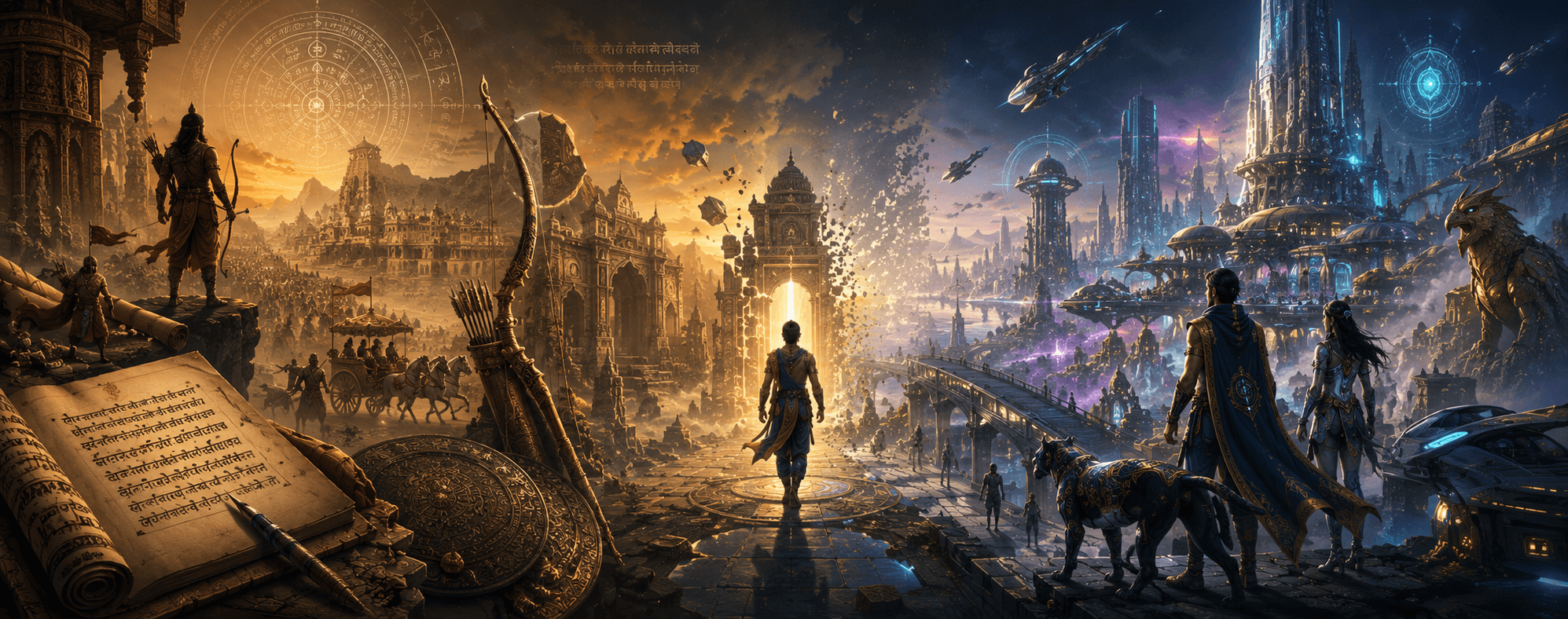
Indian cinema is entering a major mythological phase, with many large upcoming films drawing from the Ramayana, Mahabharata and other familiar stories. The opportunity is enormous. But if filmmakers repeatedly return to the same characters, worlds and conflicts, India could eventually experience something similar to Hollywood’s superhero fatigue. The answer is not to move away from mythology, but to use it as inspiration for creating entirely new stories, characters and worlds.
India Is Entering a Mythological Film Boom
Indian cinema has always had a deep relationship with mythology. In fact, some of the earliest Indian films were based on mythological and religious stories. The Ramayana, Mahabharata and stories from the Puranas have been interpreted repeatedly through cinema, television, theatre, animation and other forms of popular culture.
What feels different today is the scale at which these stories are returning. Mythology is no longer being approached only as devotional or historical material. It is increasingly becoming the foundation for large-scale blockbuster entertainment, with major stars, enormous budgets, sophisticated visual effects and ambitions to create cinematic universes around stories Indian audiences have known for generations.
There is an obvious reason for this. Indian mythology contains almost everything blockbuster cinema wants. There are extraordinary heroes, complicated villains, massive wars, supernatural weapons, monsters, transformations, family conflicts, romance, betrayal, sacrifice and worlds with almost unlimited visual possibilities.
The source material is extraordinary. But extraordinary source material does not automatically guarantee an endless supply of extraordinary films.
We Have Seen This Cycle Before
Hollywood has already gone through something similar with superhero cinema. For more than a decade, superheroes became one of the dominant forms of global entertainment. Marvel demonstrated how individual characters could be connected into a larger cinematic universe, encouraging audiences not simply to watch individual films but to follow an interconnected world over many years.
The success naturally produced more content. More films appeared, followed by more characters, spin-offs, television series and increasingly complicated interconnected storylines. Eventually, audiences began talking about superhero fatigue.
The interesting part is that audiences did not suddenly stop liking superheroes. The problem was never simply the existence of superhero films. The problem was repetition, oversupply and the feeling that too many stories were beginning to follow familiar patterns.
India could eventually find itself facing a similar problem with mythological cinema.
The Problem Is Not Mythology. It Is Using Mythology as the Destination.
There is an important difference between adapting mythology and being inspired by mythology.
Adaptation asks: how do we tell this existing story again?
Inspiration asks: what made this story powerful, and what completely new story can we create using those ideas?
That second question creates much more creative freedom.
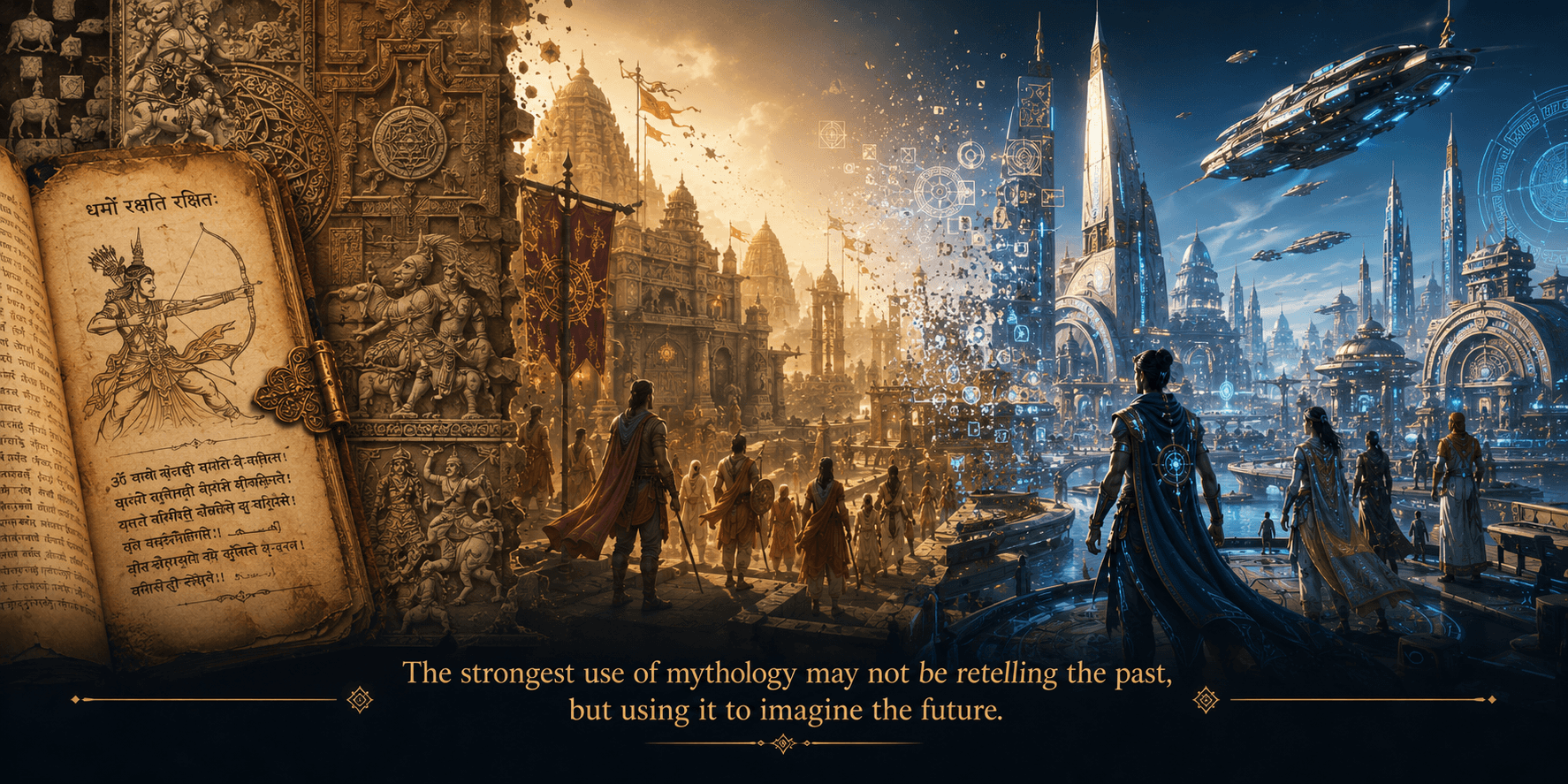
The idea of dharma can become the foundation of an entirely new political story. Reincarnation can become science fiction. The concept of different lokas can inspire a new interdimensional universe. Astras can influence an original system of technology or supernatural power. The moral complexity of Karna can inspire a completely new character without that character actually being Karna.
A story can carry the DNA of Indian mythology without directly retelling it.
That is where mythology becomes a creative foundation rather than a creative boundary.
Star Wars Shows What Inspiration Can Become
Star Wars is a useful example because its storytelling did not emerge from a vacuum. George Lucas drew from mythology, Joseph Campbell’s Hero’s Journey, samurai cinema, Westerns, religion, philosophy and older science-fiction adventures.
But he did not simply adapt an existing myth.
He created Luke Skywalker, Darth Vader, the Jedi, the Force, planets, political systems, creatures, technologies and thousands of years of fictional history around them.
The structure underneath the story may have been ancient, but the world built on top of it was new.
That distinction matters.
Audiences were experiencing familiar archetypes through characters and worlds they had never encountered before.
Warner Bros. Has Also Built New Worlds From Older Ideas
The same principle can be seen in films such as The Matrix. Its creators drew from philosophy, religion, mythology, cyberpunk, anime and ideas about reality and consciousness, but those influences became the foundation for something completely original.
The result gave audiences Neo, Morpheus, Agents, the Matrix, the red pill and an entirely new cinematic vocabulary.
The audience could feel something ancient beneath the story, but what appeared on screen felt new.
That is what strong world-building does. It absorbs influences without becoming trapped by them.
India Has Enough Mythology to Create New Mythology
India is arguably one of the best places in the world to approach storytelling this way.
We have thousands of years of mythology, philosophy, folklore, architecture, rituals, music, regional traditions and visual culture. The opportunity is not simply to treat all of this as a catalogue of existing stories waiting to be adapted.
It can become a creative operating system.
Take the philosophy. Take the moral conflicts. Take the archetypes. Take the scale. Take the symbolism. Take the relationship between humans, nature and the divine.
Then build something nobody has seen before.
Imagine a futuristic civilisation whose society has developed around ideas inspired by the nine rasas. Imagine a science-fiction world where karma can somehow be measured. Imagine different planetary civilisations inspired by the concept of lokas. Imagine an interstellar war whose emotional structure draws from the Mahabharata but whose characters, planets and history are completely original.
At that point we are no longer simply adapting mythology.
We are creating mythology.