
India Has Rides. Now It Needs Worlds.
India’s amusement industry is growing rapidly, but a bigger amusement park is not automatically a theme park. The difference is not the number of rides. It is what people come for, what they experience between those rides, and what they carry home when they leave.
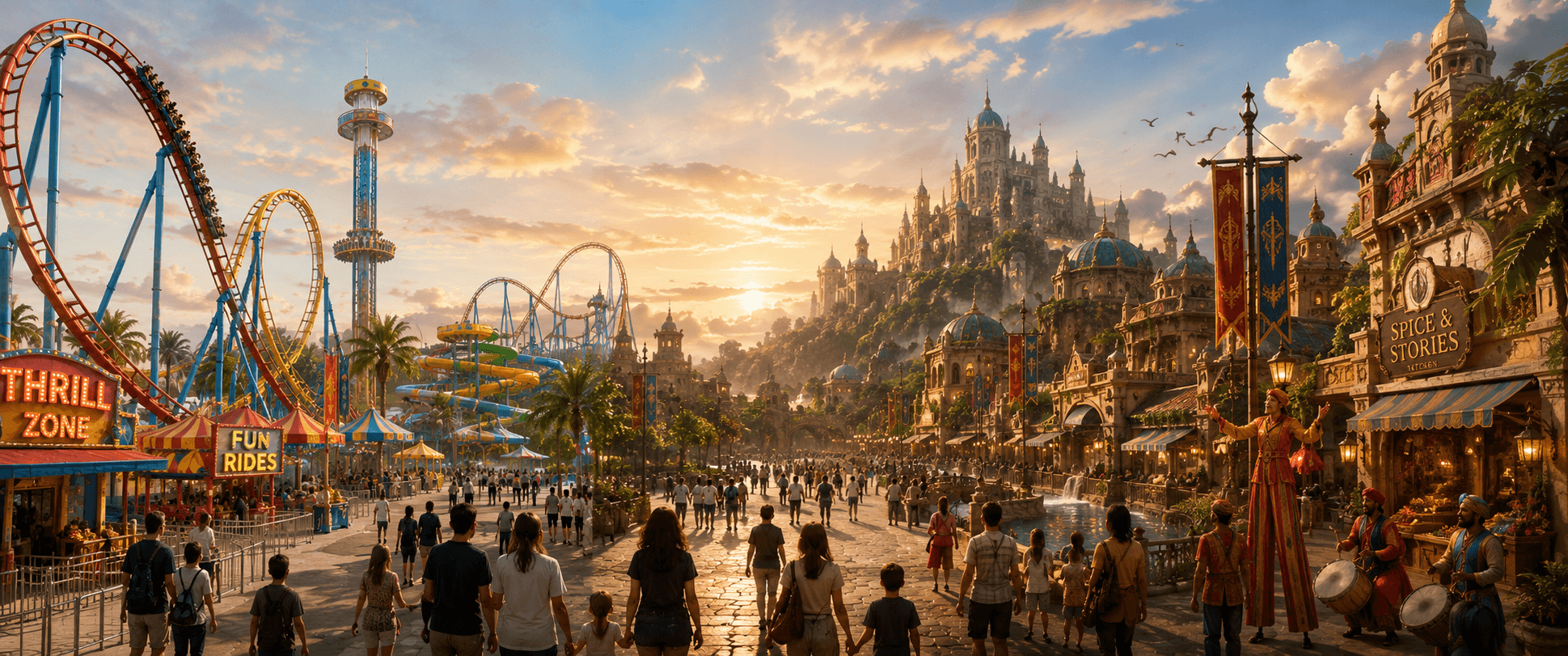
India’s Entertainment Parks Are Growing
India is entering an important period for location-based entertainment. More families are travelling, weekend recreation is becoming part of urban life, cities are expanding, connectivity is improving, and entertainment is increasingly becoming something people are willing to travel specifically to experience.
The Indian amusement and attractions industry is becoming larger and more organised, with new investment entering amusement parks, water parks, family entertainment centres and destination entertainment. The opportunity is clearly there. But as the industry grows, there is a more fundamental question we should be asking: what exactly are we building?
Because an amusement park, a water park, an adventure park and a theme park are not the same thing. In India, however, we frequently use these terms as though they are.
A Theme Park Is Not an Amusement Park With More Decoration
India certainly does not lack parks. We have roller coasters, Ferris wheels, drop towers, wave pools, water slides, go-karts, zip lines, snow parks, trampoline parks, family entertainment centres and large amusement destinations.
What India has relatively few of are destinations where the theme itself becomes the organising principle of the entire experience.
That distinction matters. Putting Egyptian columns around a roller coaster does not automatically create an Egyptian theme park. Painting a water slide to resemble a snake does not make it a themed attraction. Placing a castle at the entrance does not make everything behind it a fantasy world.
Theming is not decoration. Theming is coherence.
It happens when the environment, architecture, attractions, characters, music, food, retail, performances, landscaping and even the way employees interact with guests begin telling the same story. That is when a park stops feeling like a collection of attractions and starts becoming a world.
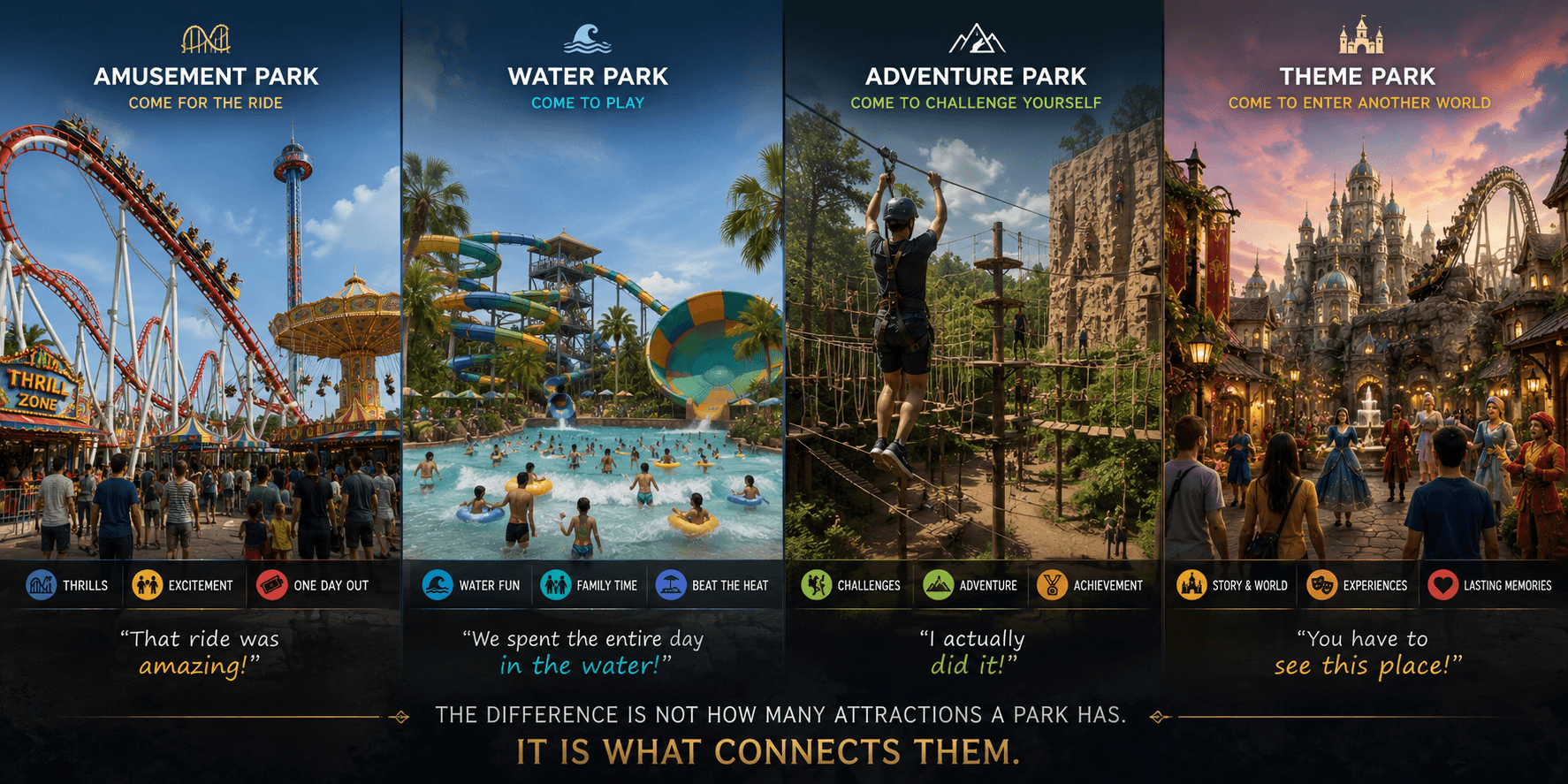
Start With a Simpler Question: Why Did the Guest Come?
Perhaps the easiest way to understand the difference between these park formats is not by looking at the equipment. Look at the guest instead.
Ask two simple questions: What did they come for? And what did they leave with?
Those two questions reveal almost everything.
An Amusement Park: You Come for the Ride
At its simplest, an amusement park is attraction-led. You see the roller coaster and want to ride it. You see the giant wheel and want to get on it. You hear about the tallest drop tower, fastest coaster or newest attraction, and that becomes one of the reasons to visit.
The individual ride is the product. The emotional exchange is fairly direct. You come looking for thrill, fun and entertainment. You leave saying, “That ride was amazing.”
There is nothing wrong with that model. Great amusement parks can create fantastic family experiences. But the memory frequently remains attached to individual attractions. Remove the major attraction and one of the major reasons for visiting disappears with it.
A Water Park: You Come to Play
The core promise of a water park is different. People come to escape the heat, spend time together and play. They want wave pools, lazy rivers, slides, splash zones and spaces where children and adults can spend several hours together.
The water itself becomes the attraction platform. You arrive expecting play, relief, energy and shared family time. You leave tired, wet and usually happy.
The memory might simply be, “We spent the entire day in the water.”
That can be a great experience, but the primary motivation remains functional. Water is what brought you there.
An Adventure Park: You Come to Challenge Yourself
Adventure parks operate on another emotional promise. A zip line asks whether you are willing to step off the platform. A climbing wall asks whether you can reach the top. A ropes course asks whether you can cross.
The experience is built around participation, physical engagement and overcoming uncertainty. You arrive looking for challenge. You leave with achievement.
The sentence becomes, “I actually did it.”
That emotion can be extremely powerful, but once again, it is different from what a theme park is trying to create.
A Theme Park: You Come to Enter Somewhere Else
A true theme park begins with a completely different promise. You are not simply coming to ride something. You are coming because you want to go somewhere.
Perhaps it is a kingdom that never existed. Perhaps it is a world from a film. Perhaps it is India’s past reimagined through mythology. Perhaps it is a futuristic civilisation. Perhaps it is a forest filled with characters. Perhaps it is an entirely original universe.
The roller coaster may still be there. The water ride may still be there. The adventure attraction may still be there. But they are no longer isolated products. They have become parts of the world.
The queue is part of the story. The ride vehicle belongs to the story. The building belongs to the story. The food extends the story. The music reinforces the story. A performer walking past you is part of the story. Even the merchandise allows you to take a piece of that world home.
The attraction is no longer just the ride. The world itself becomes the attraction.
What Do People Leave With?
This may be the biggest difference of all.
An amusement park wants you to remember the excitement. A water park wants you to remember the fun. An adventure park wants you to remember what you accomplished. A theme park wants you to remember where you went.
That changes the sentence guests use afterwards.
Instead of saying, “You should try that roller coaster,” they begin saying, “You have to see this place.”
That is a much more powerful proposition because attractions eventually age. A new roller coaster becomes an old roller coaster. The tallest ride eventually stops being the tallest. Technology gets replaced. Competitors can buy similar equipment.
But worlds can become part of culture.
Characters can remain with children for years. Families can build traditions around visiting them. Music can trigger memories. Food can become part of the ritual. A child can buy something inside the park, take it home, watch the story again and want to return.
The relationship continues even after the guest has left the park.
The Space Between the Rides Matters
One of the biggest mistakes in park development is focusing almost entirely on attraction capacity. Twenty rides. Thirty rides. Five major rides. Ten children’s rides. Two water rides. One coaster. One giant wheel.
It looks impressive in a spreadsheet. But the guest does not experience a spreadsheet.
The guest experiences everything between those attractions.
What happens when they walk from one ride to another? What do they hear? What do they smell? What do they discover? Is something happening on the street? Does the building beside them have a reason to exist? Does lunch feel connected to the world? Does the shop feel like another shop, or does it contain objects connected to the story?
Can a child interact with a character without entering a ride? Can a grandparent who does not enjoy roller coasters still participate in the experience?
These spaces between attractions are where a theme park begins separating itself from an amusement park.
In an amusement park, the pathway often connects two experiences. In a theme park, the pathway is part of the experience.
India Has an Extraordinary Advantage: Stories
This is where India’s opportunity becomes particularly interesting. We do not suffer from a shortage of stories.
Few countries have such a deep reservoir of mythology, folklore, kingdoms, landscapes, cinema, music, festivals, regional identities, crafts, food cultures and characters.
Modern India adds another layer. Our films already create enormous fictional universes. Our animation industry can create new characters. Our gaming industry is growing. Our history spans civilisations. Every state has stories that another part of the country may never have physically experienced.
There is enormous material from which immersive worlds can be created.
But a true Indian theme park should not simply mean placing mythology statues beside imported rides. Nor should it mean reproducing monuments and calling the resulting space a themed zone.
The challenge is to transform stories into experiences.
What does the guest do inside the story? Where do they enter it? Who do they meet? What do they discover? What role do they play? What changes between the moment they enter and the moment they leave?
That is experience design.
Theme Does Not Have to Mean Existing IP
There is another misconception worth challenging. A theme park does not necessarily require a famous movie franchise.
Existing films, characters and intellectual properties can provide an enormous advantage because audiences already understand those worlds. But original theme parks can build their own worlds as well.
A park can begin with a story nobody has heard before. It can create its own characters, mythology, architecture, symbols, music and rituals. The park itself can become the place where audiences first discover the IP.
That is an important shift in thinking because India’s next great entertainment property does not necessarily have to begin on a cinema screen. It could begin inside a park.
The Economics Change When the World Becomes Valuable
This distinction is not purely creative. It also changes the business model.
If the primary product is a collection of rides, a large percentage of the business naturally revolves around admission. But once people care about the world, additional opportunities begin growing around it.
Food becomes themed dining. Retail becomes merchandise. Characters become intellectual property. Hotels extend the experience overnight. Events happen inside the world. Seasonal celebrations give guests reasons to return. Shows create additional capacity without requiring another major ride.
The intellectual property can eventually move outside the park into animation, film, games, books, digital content and licensing.
This is why building a theme park is fundamentally different from purchasing amusement equipment.
You are not simply assembling attractions. You are building an entertainment property.
India Does Not Need to Copy Disneyland
The conclusion should not be that India needs an Indian Disneyland. That would miss the opportunity.
India needs its own language of themed entertainment.
It needs parks designed around how Indian families actually travel together. Our groups can include children, teenagers, parents and grandparents in the same visit. That means a successful Indian theme park cannot depend only on thrill rides.
It needs spectacle, food, comfort, shade, music, performance, water, interactive experiences, children’s play, night entertainment, cultural familiarity, discovery and places simply to sit together.
The objective should not be to copy what another country has built. It should be to understand why the world’s best theme parks create such powerful memories and then apply those principles to Indian stories, Indian audiences and Indian behaviour.
From “What Rides Should We Buy?” to “What Should People Feel?”
Perhaps that is the question that needs to change first.
When developing a park, we often begin with: What rides should we put here?
A theme park should begin somewhere else.
Where are we taking the guest?
What should they feel when they arrive? What should they discover? What should they do? What should surprise them? What should the family experience together? What should they still remember a week after they have gone home?
Only then should we ask what ride best delivers that moment.
Because rides are tools. Water is a tool. Technology is a tool. Architecture is a tool. Characters are tools. Food, music, landscaping and performance are tools.
The product is the experience created when all of them work together.
The Next Stage of India’s Park Industry
India’s amusement industry does not need to disappear for theme parks to grow. Quite the opposite.
We need great amusement parks. We need great water parks. We need great adventure destinations. We need family entertainment centres, attractions and local recreation. They serve different needs and different markets.
But as investment into leisure and tourism increases, there is room for another category to mature alongside them.
Destinations worth travelling across states for. Places where spending six or eight hours does not feel like completing a checklist of rides. Places children ask to return to because they want to see the characters again. Places adults photograph not merely because something is large, but because the environment itself is beautiful. Places families remember as journeys.
That is the opportunity.
India already knows how to build rides. It knows how to build water parks. It knows how to create extraordinary movies, music, architecture and stories.
The next step is bringing those disciplines together.
Because ultimately, an amusement park asks, “Did you enjoy the ride?”
A theme park asks something bigger: “For a few hours, did you believe you were somewhere else?”
People come to an amusement park for what they can do. They come to a theme park for where they can go. And they return because of what they felt while they were there.