
Micro-Dramas Have Learned How to Hold Us. Now They Need to Learn When to Let Go.
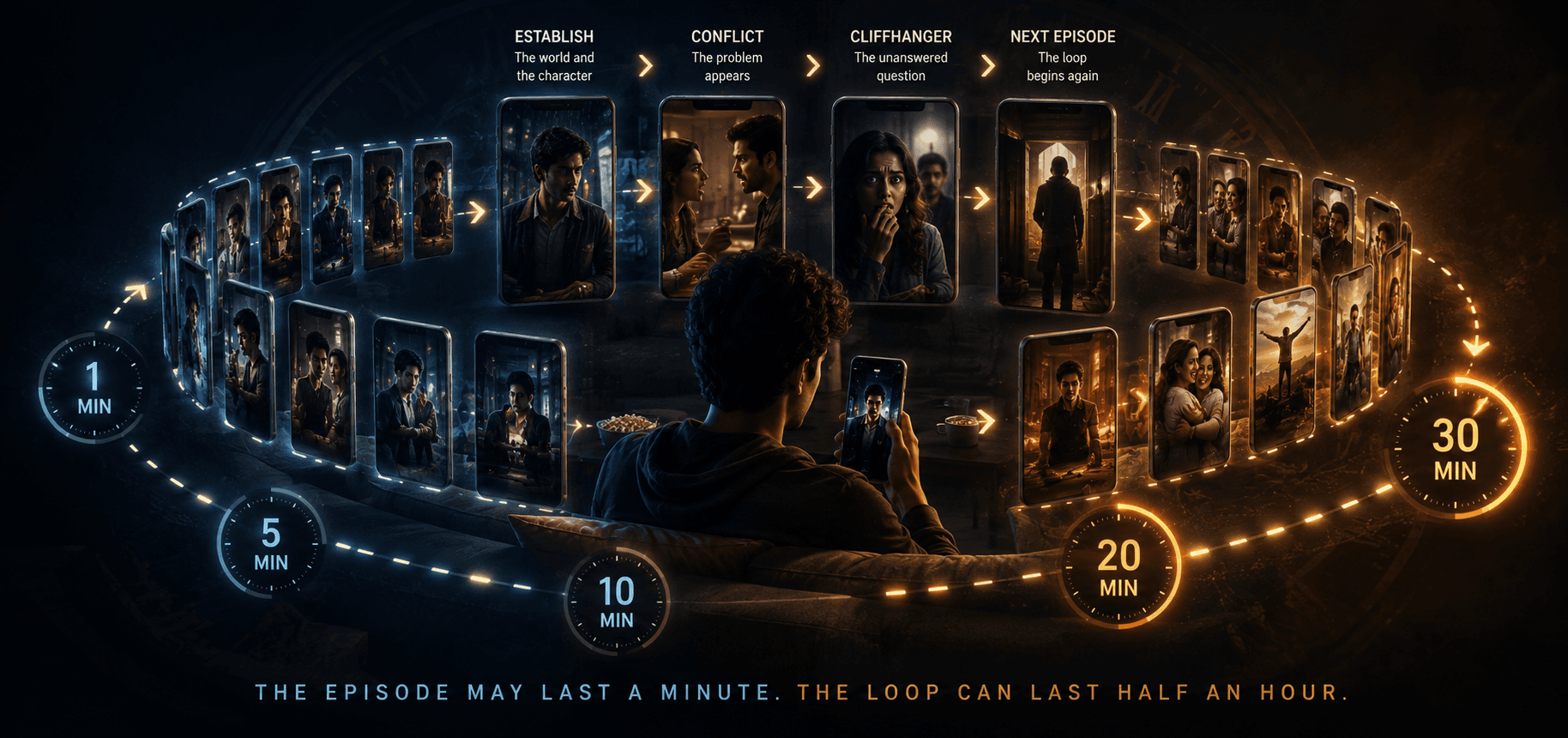
Micro-dramas have turned one-minute episodes into 30-minute viewing sessions by mastering a simple storytelling loop: establish, conflict, hook, repeat. It is proving extraordinarily effective. But as short-form storytelling becomes more powerful, the next challenge is not simply how to keep people watching. It is how to create attention that feels rewarding rather than exhausting.

The One-Minute Episode That Becomes Half an Hour
Micro-dramas are one of the most interesting changes happening in entertainment because they look incredibly small. An episode may last only one or two minutes, be filmed vertically, use relatively simple locations and tell what appears to be a straightforward story.
Yet the viewing behaviour around them is anything but small.
In India, recent research found median micro-drama viewing sessions of around 30 minutes, with audiences returning several times each week. In the US, Omdia reported that ReelShort users were spending an average of 35.7 minutes per day on the app, more mobile viewing time per user than Netflix, Prime Video or Disney+ during the same measured period.
So perhaps we should stop thinking of micro-drama as one-minute entertainment. What audiences are actually consuming is a 20- or 30-minute experience divided into a sequence of tiny decisions.
You never really decide to watch for half an hour.
You decide to watch for one more minute.
And then one more.
The Structure Is Almost Perfectly Built for Continuation
Micro-dramas have reduced storytelling to an extremely efficient loop: establish the situation, introduce conflict, create a hook, then repeat.
A woman discovers something about her husband. Before she can confront him, someone enters the room. Cut. The next episode explains who entered, but immediately reveals another secret. Cut. That secret creates another confrontation. Cut.
Every episode gives the viewer just enough resolution to feel rewarded, but not enough to feel finished.
Traditional storytelling often asks an audience to invest over a longer period before delivering a major emotional payoff. Micro-drama dramatically shortens that distance. The reward comes quickly, but so does the next unanswered question.
This is why even relatively underwhelming content can remain extremely watchable. The production may not be extraordinary. The dialogue may be predictable. The situation may even be ridiculous.
But momentum can be stronger than quality.
You may know that what you are watching is not particularly sophisticated and still want to know what happens next.
That is an important distinction. Great entertainment makes us want to stay because we care deeply about the story. Highly optimised entertainment can make us stay because leaving feels slightly uncomfortable.
The One-Minute Episode That Becomes Half an Hour
Micro-dramas are one of the most interesting changes happening in entertainment because they look incredibly small. An episode may last only one or two minutes, be filmed vertically, use relatively simple locations and tell what appears to be a straightforward story.
Yet the viewing behaviour around them is anything but small.
In India, recent research found median micro-drama viewing sessions of around 30 minutes, with audiences returning several times each week. In the US, Omdia reported that ReelShort users were spending an average of 35.7 minutes per day on the app, more mobile viewing time per user than Netflix, Prime Video or Disney+ during the same measured period.
So perhaps we should stop thinking of micro-drama as one-minute entertainment. What audiences are actually consuming is a 20- or 30-minute experience divided into a sequence of tiny decisions.
You never really decide to watch for half an hour.
You decide to watch for one more minute.
And then one more.
The Structure Is Almost Perfectly Built for Continuation
Micro-dramas have reduced storytelling to an extremely efficient loop: establish the situation, introduce conflict, create a hook, then repeat.
A woman discovers something about her husband. Before she can confront him, someone enters the room. Cut. The next episode explains who entered, but immediately reveals another secret. Cut. That secret creates another confrontation. Cut.
Every episode gives the viewer just enough resolution to feel rewarded, but not enough to feel finished.
Traditional storytelling often asks an audience to invest over a longer period before delivering a major emotional payoff. Micro-drama dramatically shortens that distance. The reward comes quickly, but so does the next unanswered question.
This is why even relatively underwhelming content can remain extremely watchable. The production may not be extraordinary. The dialogue may be predictable. The situation may even be ridiculous.
But momentum can be stronger than quality.
You may know that what you are watching is not particularly sophisticated and still want to know what happens next.
That is an important distinction. Great entertainment makes us want to stay because we care deeply about the story. Highly optimised entertainment can make us stay because leaving feels slightly uncomfortable.